Why SIEM Is More Important Than Its Operational Overhead
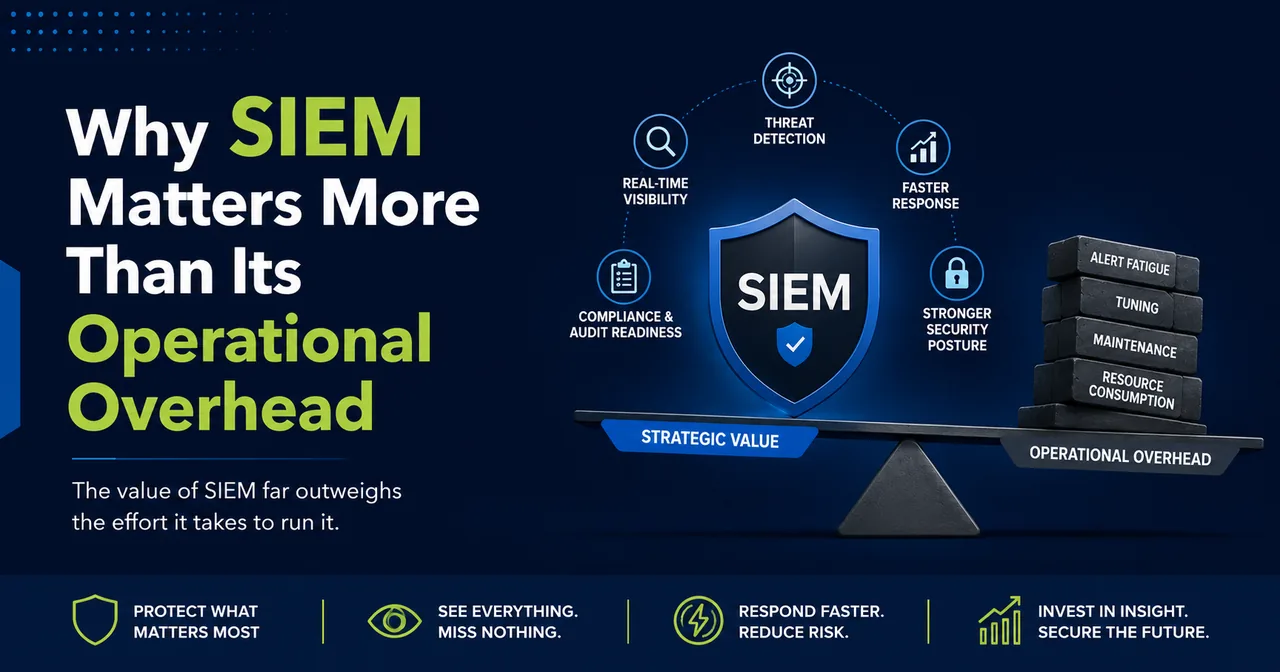
Why SIEM Is More Important Than Its Operational Overhead
Most teams look at SIEM and see cost first.
Storage, licensing, alert noise, the endless tuning — there's always someone in the room who has a strong opinion about whether it's "worth it." And honestly, I get it. SIEM is not cheap, and a poorly managed one can feel like it generates more work than it prevents.
But I think that framing misses the point entirely.
A SIEM isn't just a monitoring tool you can swap out or skip. It's the thing that gives you actual visibility into what's happening across your environment. Without it, you're guessing — and in security, guessing is expensive in a very specific way.
Security decisions run on data
Every incident response, every detection rule, every forensic question starts with logs.
If you're not collecting from your servers, firewalls, endpoints, cloud platforms, and authentication systems, you don't have a complete picture. You might have individual tools doing their thing, but each one only sees its own corner of the environment. The problem is that attacks rarely stay in one corner.
SIEM brings all of that data into one place — normalized, searchable, and ready to be correlated. That sounds like a nice feature. In practice, it's the difference between catching something and finding out about it weeks later from a third party.
Correlation is where it gets interesting
Raw logs are almost useless at scale. A busy environment generates millions of events a day, and no one has the time to manually review them.
Correlation is what makes the volume manageable. A failed login on its own means nothing. Pair it with a new admin account created five minutes later, some unusual PowerShell activity, and a connection to an IP that's never appeared in your environment before — now you have something worth investigating.
This is where a well-tuned SIEM earns its keep. It doesn't just collect data; it helps you find the signal in the noise. That's not something you can replicate with a bunch of separate tools and a spreadsheet.
Retention is underappreciated until you need it
Most people don't think much about log retention until they're in the middle of an incident investigation and the logs they need are gone.
Breaches are often discovered long after the initial compromise. Weeks, sometimes months. When that happens, the first set of questions is always the same: when did this start, what did the attacker do, and how far did it spread? Without retained logs, those questions either take much longer to answer or can't be answered at all.
SIEM gives you that historical record in a structured format. It's useful for incident response, forensics, internal reviews, and compliance audits. Auditors asking for evidence of privileged activity from six months ago shouldn't be a problem — it should be a ten-minute report.
Dashboards matter more than people admit
I've seen security teams that have all the right data but can't act on it quickly because they can't make sense of it fast enough. Dashboards, alert views, and timelines aren't just cosmetic — they shape how quickly someone can orient during an incident.
A good SIEM lets security teams see trends, spot anomalies, and understand system behavior without having to dig through raw logs for every question. That matters when something is actively happening and time is short.
It also matters for the business side. Executives don't need log exports — they need risk summaries and evidence that controls are actually working. SIEM makes that conversation possible.
Real compliance vs. compliance on paper
This distinction matters a lot in practice.
A lot of organizations are "compliant" in the sense that they have the right documents, policies, and procedures. But real compliance means being able to detect events, prove they occurred, and show you responded. That's a different bar.
SIEM supports both sides. On the evidence side, it shows that logs are being collected, retained, and actively monitored. On the operational side, it's actually doing the work — detecting unauthorized access, surfacing policy violations, and giving you the traceability that audits require.
If you ever have to answer questions about a specific event from three months ago, the difference between having a SIEM and not having one becomes very concrete, very fast.
Yes, the overhead is real — but so is the alternative
SIEM takes real work. Tuning rules, managing alert volume, keeping use cases relevant, making sure the right sources are onboarded — it's not something you set up once and forget.
But the cost of not having it isn't zero either.
Without SIEM, incidents take longer to detect. Investigations take longer to run. Compliance evidence is harder to produce. And your security team is making decisions based on incomplete information, which is a different kind of risk that doesn't show up on a cost spreadsheet.
The real question isn't whether SIEM creates overhead. It's whether your organization can absorb the consequences of operating without centralized visibility, detection, and retention. In most environments I've worked in, the answer to that is no.
SIEM isn't a checkbox. It's what moves security from reactive to informed — from "we think we're okay" to "here's the evidence." The overhead is manageable. The alternative is not.